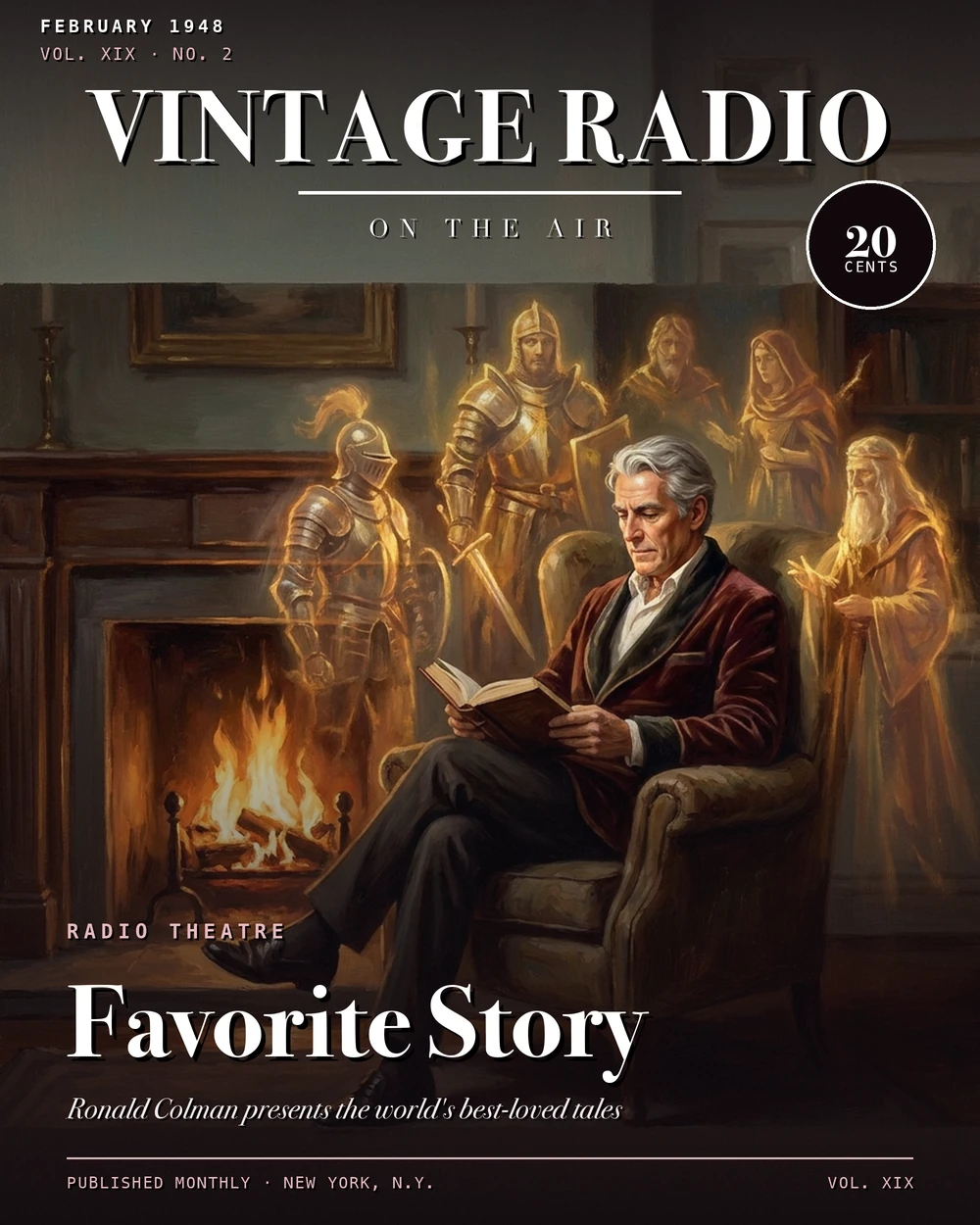
Favorite Story
A Deal That Shook the Radio Industry
When writers Jerome Lawrence and Robert E. Lee approached Ronald Colman in 1947 about hosting a syndicated drama built around classic literature, what followed became one of the more talked-about business moves in American radio. Negotiations ran more than six months, but Ziv — the syndication company behind the show — eventually landed Colman on terms that included a percentage of sales revenue in addition to his fee. Time magazine called the deal "an earthquake that might upset the whole map of U.S. commercial radio" if other established stars began leaving network programs for transcribed syndication.
The numbers varied depending on the source. One account puts Colman's fee at $5,000 per group of twelve shows plus $3,500 for the thirteenth, with ten percent of revenues capped at $7,500; another gives a flat $3,000 per episode against a total production cost of roughly $9,000. What's consistent is that Colman's contract guaranteed him $150,000 a year for at least three years, and that he was allowed to record at his own convenience, fitting radio work around his film schedule. That flexibility was essential — without it, a busy film actor like Colman would never have signed.
Ziv moved quickly to capitalize on the publicity. The company launched a national contest offering a $1,000 prize for the best listener-submitted nomination of a favorite story from literature, with a $500 bonus to the station judged most effective at promoting it. Frederick Ziv later summed up what Colman's name had done for the program's commercial prospects: "Stations were receptive, networks were receptive, sponsors were receptive, audiences were receptive." The first fifty-two episodes were pressed and a hundred-man sales force was dispatched across the United States and Canada to market them. Favorite Story helped push Ziv's 1947 gross revenues up roughly 30 percent to an estimated $10.4 million, and Colman's presence made it considerably easier to recruit other major film names — Dana Andrews, Irene Dunne, Fred MacMurray, Adolphe Menjou, Humphrey Bogart, and Lauren Bacall — into subsequent Ziv productions.
How the Show Actually Worked
Favorite Story had started more quietly, as a local dramatic offering on KFI in Los Angeles. The earliest broadcasts, dating to the spring and late summer of 1946, went out under the titles My Favorite Story and Your Favorite Story interchangeably. The first sponsor was Bullock's Department Stores of Los Angeles, which backed the initial thirteen episodes. Ziv also brought in publisher George Putnam as an editorial consultant, a move calculated to add literary credibility to the enterprise. By the time Colman came aboard, the show had found both its format and its national ambitions.
The premise was simple: prominent personalities would nominate a "favorite story" from literature, and that story would be dramatized in the half-hour slot. In practice, the celebrity nominators never actually appeared on air — they had been sent a list of works to choose from, and their compensation took the form of on-air promotion for whatever book, film, or other project they had coming up. Jane Crowl's selection of Brigadoon, dramatized on February 17, 1948, illustrates the format in action. The device gave each episode a conversational entry point while keeping the content rooted in the source material.
The works themselves ranged across the literary canon: Vanity Fair, Pride and Prejudice, The Three Musketeers, The Moonstone, Huckleberry Finn, The Legend of Sleepy Hollow, Dr. Jekyll and Mr. Hyde, and Twenty Thousand Leagues Under the Sea, among others. Condensing a full novel into thirty minutes is a severe constraint, and Tim DeForest wrote in Radio by the Book: Adaptations of Literature and Fiction on the Airwaves that "In many cases, Favorite Story managed the incredible feat of jamming a classic novel into half an hour and still giving us a rewarding experience."
The Writers Behind It
Jerome Lawrence and Robert E. Lee were the producer-writers who built and ran Favorite Story, and their involvement is inseparable from understanding what the show was. Lawrence was born in Cleveland in 1915 and graduated from Ohio State University in 1937; Lee was born in Elyria, Ohio, in 1918. They met in New York in January 1942 and formed a writing partnership that lasted fifty-two years. During World War II, they were among the founders of the Armed Forces Radio Service and worked on Command Performance, Mail Call, and Yarns for Yanks. Favorite Story became one of their signature radio programs, and they were described at the time as "the most prolific writing partnership in radio."
Lawrence and Lee received two George Foster Peabody Awards for Distinguished Achievement in Broadcasting, in 1949 and 1952. After radio, they wrote Inherit the Wind in 1955 — the landmark stage play based on the Scopes Trial that established them as major figures in American theater. Robert E. Lee married actress Janet Waldo in 1948; Waldo was also a regular performer on Favorite Story, and she later became widely known as the voice of Judy Jetson.
Beyond their writing, Lawrence and Lee shaped the institutional memory of the program. Scripts, reviews, promotional materials, and audio recordings from Favorite Story are preserved in the Jerome Lawrence and Robert E. Lee Collection at the Jerome Lawrence and Robert E. Lee Theatre Research Institute at Ohio State University, with initial materials received in 1972. A collection of recordings described as containing the first 120 programs is also held at the Rodgers and Hammerstein Archives of Recorded Sound at the New York Public Library for the Performing Arts, donated by Lawrence and Lee. The Ziv Company's master archive is held at the Wisconsin Center for Film and Theater Research.
The Cast and Crew
Ronald Colman brought more to Favorite Story than his name and his voice. He had measurable creative input into the production, including suggestions about how scripts should adapt source material for radio. As a performer, Colman appeared not only as narrator-host but as an actor in selected episodes. His reputation was further enhanced when he won the Academy Award for Best Actor in 1948 for A Double Life — which Ziv promptly used to generate additional promotional attention for the show. Colman had previously received Oscar nominations for Bulldog Drummond and Condemned in 1929 and for Random Harvest in 1942. He was in his mid-fifties during the run of Favorite Story.
The supporting cast drawn from Hollywood radio represented a strong roster of working actors. Hans Conried, Lurene Tuttle, William Conrad, Janet Waldo, Joseph Kearns, Raymond Burr, Vincent Price, Howard Duff, and Jeff Corey were among the performers heard across episodes. Herb Butterfield, Byron Kane, Jimmy Lydon, Eric Snowden, Norman Field, Gloria Gordon, John Beal, Helen Craig, Berry Kroeger, Edmund MacDonald, Edna Best, and Lionel Stander also appeared regularly. Claude Sweeten led the orchestra, and Jack Hayes handled sound effects.
After the Run Ended
Production wrapped in late 1949 after 118 episodes, with the final KFI broadcast dating to April 19, 1949. Ziv's distribution model meant the show's life extended well beyond that endpoint. The company's approach was to sell programs first to independent stations in major markets, then resell the same episodes to smaller regional stations — where a station might pay as little as $12 per episode — on the assumption that audiences there hadn't heard them. Episodes continued to air in local markets for years after production stopped. In September 1951, WNBC-AM, NBC's flagship New York City station, purchased Favorite Story along with several other Ziv programs for a 52-week run, demonstrating that network-affiliated stations were also buying syndicated product.
Ziv Television Programs later adapted the radio format into a television anthology titled Your Favorite Story, which aired in syndication from 1953 to 1955 and was hosted by Adolphe Menjou. During its first season, from January to July 1953, it broadcast on NBC-TV on Sunday evenings. Lawrence and Lee wrote teleplays for the television version, and directors included Lewis Allen and John Guillermin. Raymond Burr appeared in the program's initial episode, an adaptation of Leo Tolstoy's "How Much Land Does a Man Need?" The television version went out at various points under the titles My Favorite Story and Your Favorite Playhouse. Colman's positive experience on the radio program is credited as a likely factor in his decision to embark on the radio comedy The Halls of Ivy in 1950 with his wife, Benita Hume. Favorite Story's commercial success, meanwhile, contributed to Ziv being described by 1948 as the largest packager and syndicator of radio programs in the country.